 Explore Maharashtra
A Stepwell Carved Entirely from a Single Rock
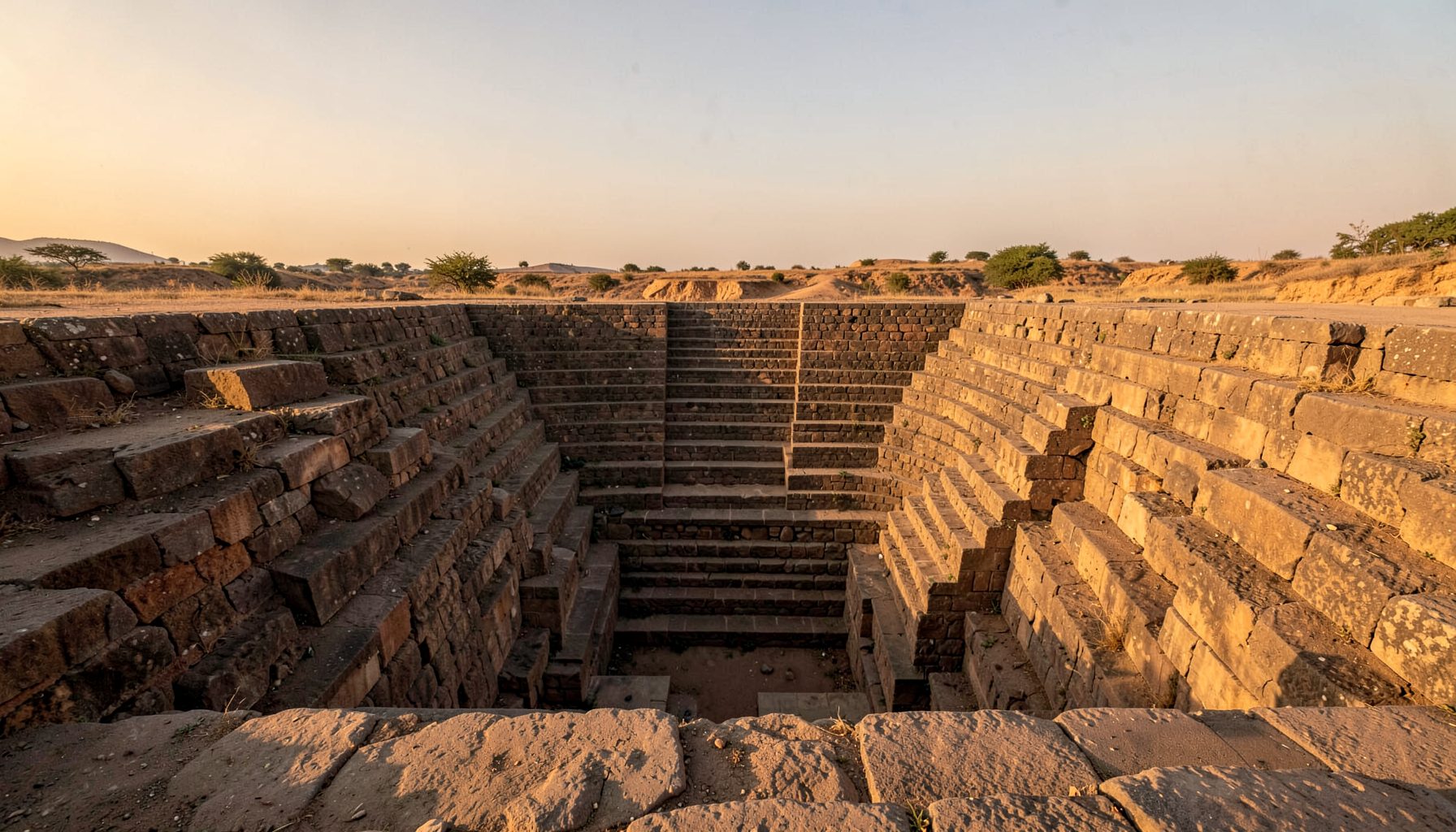
At first glance, Bharat Baoli near Bhugaon in Pune district can be mistaken for a sunken stone court. Flights descend in orderly tiers toward water, while later repairs and vegetation soften the original geometry. Up close, the monument reveals a more demanding achievement: steps, landings, walls and chambers excavated from a continuous body of Deccan basalt rather than assembled from separate blocks.
A stepwell carved entirely from a single rock compresses several histories into one place. It is a water-work shaped by geology, a civic institution managed by people and often a sacred precinct renewed through ritual. At Bharat Baoli, the cut edges, changing waterline and surrounding settlement reveal why architectural form must be read alongside local memory rather than treated as an isolated monument.
The Monolithic Baoli of Bhugaon
At Bhugaon, west of Pune, a settlement steadily absorbed by urban expansion, Bharat Baoli forms part of a changing sacred and residential precinct. Traces of repair and reuse overlap the original work. The monument is generally associated with the medieval Deccan, yet its history is best understood as a sequence of uses rather than a single moment preserved intact.
Here, monolithic means excavated from one continuous rock mass, not transported as a giant portable block. Joints and mortar beds are absent from the original carving. Water entering fine fractures can weather the baoli as a single structural body, while later cement and rebuilding conceal how that body was originally shaped.
Its significance lies in construction and continuity. The geometry demonstrates what craftspeople could achieve in basalt and is often discussed alongside the Deccan’s Hemadpanti building tradition. Centuries of access, worship and upkeep also show a structure answering living needs. Each phase deserves respect: ancient carving is not a backdrop for later additions, and later additions are not automatically less valuable.
Reading the Architecture of a Rock-Cut Well
Movement toward water is arranged as an architectural sequence. Broad stairs establish human scale, landings create places to pause, and the narrowing descent concentrates attention on the reservoir. Openings admit light and air, making a shaded transition between the hotter surface and cooler underground. The result is practical climate control and a carefully choreographed civic space.
The water system served purposes beyond storage. In the wider stepwell tradition, basins gather seasonal runoff, encourage percolation into aquifers and make groundwater accessible during dry periods. Whether water is filtered through sediment or drawn directly from an aquifer depends on design, so changing hydrology matters as much as visual symmetry.
Across India the same basic idea appears under names such as bawdi, baoli, vav, kund and barav. In Maharashtra, differences between regions are revealing: geology, rainfall, caste patterns, craft traditions and water rights all shaped local forms. The Maharashtra campaign treats these structures as a connected regional record, preserving their settings before redevelopment or neglect makes detailed comparison harder.
Stone, Water and Skilled Labour
Working basalt sets real limits. The stone must be mapped for natural joints and removed in a sequence that keeps the steps stable and walls sound. Tool marks, rough preparation and smoother worn surfaces can distinguish original cuts from later dressing, although the grain of basalt often erases finer evidence of individual tools.
Weathering makes the task more urgent. Thermal movement, roots, salts and fluctuating groundwater can widen fissures, blunt carved edges and encourage plants to settle in shaded joints. A monolithic structure can fail along the same few planes of weakness, making a small crack more consequential than it would appear in a wall built from replaceable blocks.
The carving also carries social history. Repeated landings, worn thresholds and places beside the water reveal where people gathered, waited and crossed paths. These traces may connect the baoli with temple traditions, household supply, washing and neighbourhood exchange. Reading them alongside inscriptions and oral accounts prevents the monument from becoming an elegant shape detached from the community that sustained it.
A Living Monument in a Changing City
Bhugaon’s relationship with the baoli extends beyond its role as a tourist attraction. Families have long understood particular steps, corners and approaches through use, while nearby religious activity has helped keep the place socially present. Such knowledge can be precise: one ledge may serve as a place for offerings, while another may sit where rainwater collects.
Urban growth now sets a harder timetable. Traffic, altered drainage, groundwater extraction and construction can affect conditions that appear unrelated to tourism. Public access may be restricted by safety concerns, while informal repair can obscure original surfaces. Conservation must combine engineering evidence with an understanding of who uses the site, on which days and for what purposes.
For Australian readers, the climate comparison is immediate. Sydney households often store rainwater for dry summers, Melbourne’s drought restrictions have made water accounting a routine civic concern, and Adelaide’s hotter summers keep shade and accessible drinking water firmly on the public agenda. The custom of pausing for chai after a heritage walk has an echo among the Indian food stalls of Adelaide Central Market, where recipes and place stories pass between vendors and shoppers.
Recording the Monument in Its Present State
A monument should be recorded before restoration erases the evidence needed to understand it. Original photography establishes texture and colour, measured sketches clarify geometry, and carefully planned drone imagery reveals how the baoli sits within roads, homes, drainage and worship routes. Each image becomes more valuable when its date, viewpoint and purpose are recorded with equal care.
More broadly, the site’s purpose is to present Indian Stepwells as an independent documentation project. Heritage photography, architectural drawing and field research create a layered public record, while exhibitions and education carry it beyond specialists. A digital image cannot replace physical inspection, but it can show change between visits and place the baoli within a wider history.
The strongest records also identify absences. An empty chamber, blocked drain or vanished temple feature can be as informative as a visible carving. Community contributors may know who made an alteration, where material was taken or how a ritual changed, while local workers can identify modern features invisible to a distant eye. Responsible documentation distinguishes firm evidence from interpretation and gives sources credit for the knowledge they hold.
Why Local Memory Completes the Record
Oral history is valuable because official records tend to privilege stone, inscriptions and named elites. A resident’s account may explain a seasonal water rule, a family maintenance practice or the reason a path bends around the baoli. These accounts should be attributed, checked where possible and stored with consent, allowing community knowledge to enrich the physical record without being treated as folklore.
A useful parallel comes from the history of Achill Island’s lost graveyard, where surviving stories and physical traces illuminate a community’s experience of loss and place. The Irish example is not a comparison of building types; it demonstrates how an apparently marginal site can preserve a larger social history. Naming the people connected to a place also prevents heritage from being detached from human consequences.
The same principle applies to an Indian stepwell. Its stone can be studied in detail, yet its full significance depends on remembered practices, changing access and present relationships with water. Fieldworkers should record uncertainty openly and revise interpretations when new testimony or imagery emerges. Technical observations and community memory become strongest when neither is asked to stand in for the other.
A Practical Framework for Care and Continuity
Preservation should begin with care rather than conspicuous new work. A clear assessment of cracks, drainage, water chemistry and public safety can guide a sequence of small, reversible actions. The aim is to retain the carved rock, its use and its associations while allowing damaged fabric to remain legible rather than being replaced with an idealised reconstruction.
- Commission a structural and hydrological condition survey before altering the basin.
- Photograph and measure carved surfaces, repairs, waterlines and surrounding changes.
- Track seasonal water levels and chemistry to identify active causes of deterioration.
- Use compatible repairs and retain original material wherever its position is stable.
- Include residents, temple caretakers and local workers in monitoring and decisions.
- Maintain a public archive linking photographs, oral histories and conservation records.
A programme built this way keeps the baoli grounded in everyday life while protecting the evidence that gives it value. The stone remains strong when water, architecture and community history are understood as parts of the same record.
Get in Touch
Have information about a stepwell that is not yet on our map? We would be glad to document it and give you full credit. Whether it is a Barav, Kund, Vihir, or any other form of stepwell, every contribution helps preserve India's water heritage.
Call or message us with details about the location, and we will follow up.
#9372496819
Send a Message
What People Say
"The Maharashtra Stepwells campaign has brought attention to structures that were nearly forgotten. The architectural documentation and drone photography are invaluable resources for researchers and students alike."
"Collaborating with the Indian Stepwells team gave our architecture students hands-on exposure to traditional water-harvesting structures. The presentations were insightful and inspiring."
"I shared details of a stepwell near my village that was not on any map. The team visited, documented it beautifully, and credited me. It felt wonderful to contribute."